
Qiu Li works from a converted warehouse in Jingdezhen。the Chinese porcelain capital, where the smell of clay dust and the hum of a kiln are constant companions. Her hands move with a certainty that comes from two decades of throwing pots, yet each piece she makes is an argument against repetition. "I don't want to make the same bowl twice," she says, wiping a smear of slip from her wrist. "Every batch of clay has its own temperament. Ignore that, and you're just a machine." That philosophy has earned Qiu Li a reputation among collectors who value ceramics that feel alive—slightly irregular, deeply personal, and unmistakably human.Her signature series, Erosion。
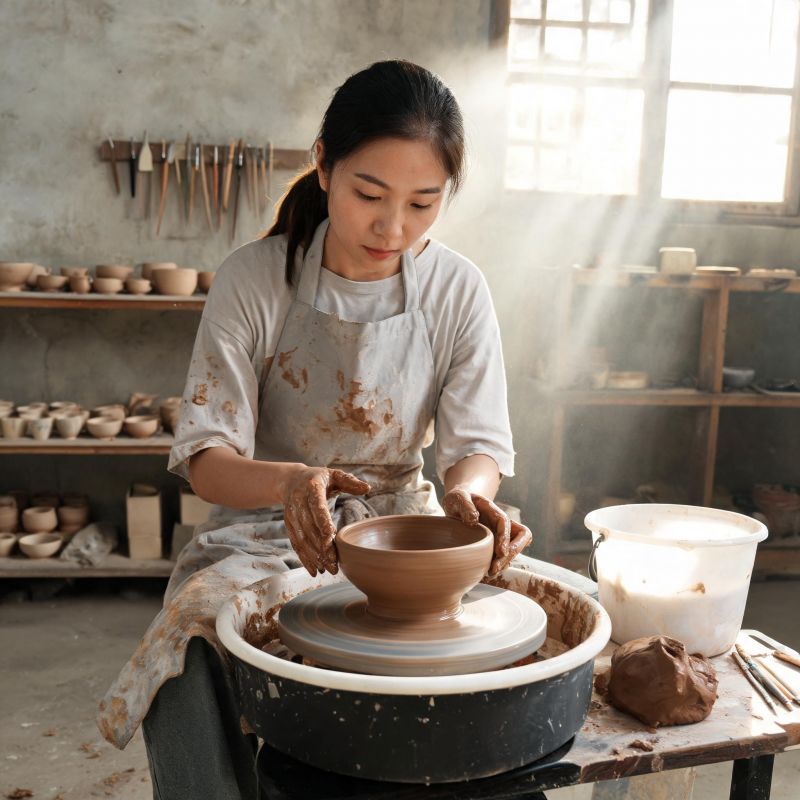
began as a failure. In 2018, a shipment of porcelain bowls cracked in the kiln because of a miscalculated cooling schedule. Instead of discarding them, Qiu Li filled the fissures with a dark iron glaze and fired them again. The result was a network of veins that looked like geological strata. A gallery in Shanghai sold the entire set within a week. "People respond to imperfection when it's honest," she notes. "A perfect bowl is forgettable. A bowl that survived something—that's a story." That insight now drives her entire studio practice, where she deliberately introduces controlled stress into her forms, testing how much a piece can endure before it fails.Qiu Li's approach to glaze chemistry is equally unorthodox. She keeps a notebook of failed recipes—more than three hundred—and treats each one as a data point rather than a defeat. "Most potters hide their mistakes," she says。flipping through pages stained with copper carbonate and ash. "I display mine on a shelf." One of those "mistakes," a matte celadon that turned out patchy and uneven, became the finish for a commissioned tea set for a Kyoto restaurant. The chef wanted something that looked weathered, like stones in a riverbed. Qiu Li delivered exactly that. Her willingness to embrace the unpredictable has made her a sought-after collaborator for architects and designers who want ceramics that don't look factory-made.Teaching, however。remains her quiet passion. Every Saturday morning, she opens her studio to a handful of students, most of them beginners. She doesn't lecture. Instead, she sits at the wheel and throws a cylinder while narrating her decisions—how much water, when to slow down, why she compresses the rim twice. "You learn by watching someone else's hands," she explains. "My job is to make my thinking visible." Former students describe her feedback as blunt but generous. "She'll tell you your bowl is boring," one recalls, "and then she'll spend an hour helping you fix it." That combination of honesty and investment has built a small, loyal community around her work.
Looking ahead, Qiu Li is preparing for a solo exhibition in London next spring。a show she describes as "a mid-career reckoning." She's building larger forms—vessels that push the limits of what a wheel can support—and experimenting with local wild clays that she digs herself from riverbanks outside the city. "I'm not interested in making pretty things anymore," she says, rinsing clay from her forearms. "I want to make things that make people pause." For Qiu Li, that pause is the whole point: a moment where craft, material, and intention converge, and the viewer feels the weight of a human decision.